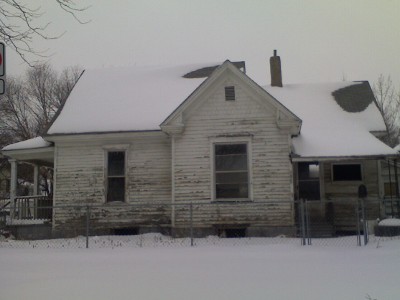
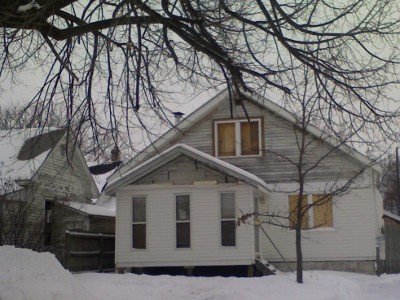
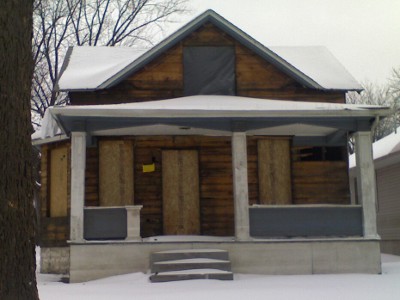
Once in a while, someone takes a cheap shot at a place like West Des Moines, and when pressed to back that cheap shot with a real argument, they might fall back on the tired old argument that the suburbs are filled with cookie-cutter houses. Aside from being a reflexive and unthinking dismissal of the places where half of all Americans choose to live, the "cookie-cutter" argument doesn't really make any sense.

All residential developments constructed around the same time in the same location will tend to look the same, because they will tend to use the materials and methods of construction most economical and most popular at the time. That's just a fact of basic economics. No reasonable person would look at the Anasazi cliff dwellings and argue that they should have been constructed out of timber, or ask why the sodbuster houses weren't made of brick. People construct their homes from the materials that are available and economical at the time.

This alone should be enough to dismiss the "cookie-cutter" myth -- or, at least, to show that sameness is hardly unique to the suburbs. But let's take the discussion a step farther:

The point to this is that uniformity itself is no real shortcoming; it's basically inevitable. The difference happens to be that people are quicker to recognize and complain about uniformity when it's new, rather than when it's old (thus Beaverdale's uniformity gives the neighborhood "character", while West Des Moines developments are criticized as "cookie-cutter"). The people who complain about suburban "uniformity" are really only repeating and reinforcing their own prejudicial dislike of suburbs (or perhaps of suburban dwellers). They're welcome to retain those prejudices, but nobody should mistake that prejudice for fact.

How much snow?

| | Comments (0) | TrackBacks (0)
The National Weather Service has a lot of details about how much snow has fallen on Des Moines this year, and how much of it has stuck around for how long. But the real metric that matters is how much snow has fallen so far this winter, versus the amount that's fallen in any other winter...

1. 52.4 inches in 2009-10
2. 50.6 inches in 1885-86
3. 46.1 inches in 1904-05
4. 43.2 inches in 1983-84
5. 41.0 inches in 2000-01

And now there's more snow on the way this weekend. Yippee.
The National Weather Service says that there's a 96% chance that the Raccoon River will go through at least some minor flooding in Des Moines this spring, and an 86% chance that the Des Moines River will do the same. Time to batten down the hatches -- especially if there's any meaningful rain this spring.
There's an inbound snowstorm that's supposed to drop another 2" of snow on our heads today, so the normal rounds of parking bans are falling into place. West Des Moines has imposed one from now until 5:00 pm on Tuesday, which means it's likely Des Moines will be doing the same soon enough. Des Moines has an interactive map showing the progress of snow removal all over the city.
The winter weather this year has felt extraordinarily bad, but it's hard to tell whether we're just imagining our oppression -- especially since it's been almost a year since the last round of winter weather, and that intervening year included tornado season. But the kind folks at the National Weather Service have confirmed our victimhood this year: Only once has there been more snow in Des Moines in December and January than we've had this winter, and only twice have we gone longer with snow on the ground.

Seriously, Nature: Knock it off.
In case you're looking for abundant political fun to be had this weekend, your options are aplenty. Those hoping to find out all the gory details of municipal budgeting can sit in on the West Des Moines city budget workshop starting at 8:00 on Saturday morning. And then, if that hasn't fulfilled all of your hopes and dreams, you can migrate to your precinct caucuses to help set the Republican or Democratic party agendas for the state in 2010.
digitalbillboard.jpg
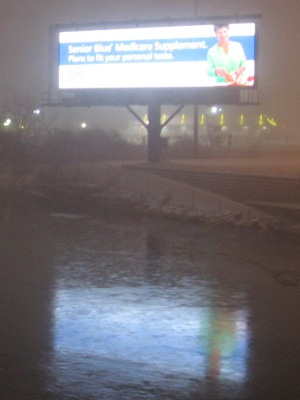
The number of digital billboards in the Des Moines area continues to grow -- they're along Grand Avenue, Ingersoll, Army Post, and I-235 on the east side now, among other places. The question is: Are they better than their printed contemporaries? On the positive side, they're more modern, in a sense, and they can be used to transmit emergency information like Amber Alerts and weather warnings if necessary. But on the negative side, they're incredibly bright, create noise, and can be distracting to drivers. They're definitely better than street spam, but it's hard to see how nostalgic we'll be about these gigantic slow-motion television sets in 50 years. They certainly won't have the same sort of "found" appeal that faded old painted signs offer today.
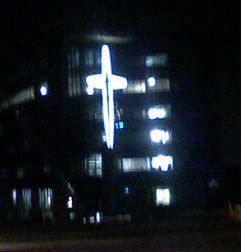
Mercy has opened its new West Lakes hospital, and so far, they've been behaving and keeping the lights off that form a gigantic white cross on the side of the building. Their cooperation in keeping things toned down will be much appreciated. The presence of two new west-side hospitals (Methodist West opens next month) ought to be mostly beneficial to the area, since it moves high-quality health-care service closer to the ever-growing west-side population, but it remains to be seen how the air and ground ambulance services will add to the noise in the area. It's a new thing to have helipads in West Des Moines.
The City of Des Moines is considering adding red-light cameras to intersections and Interstate 235 off-ramps. Clive already has them in six locations, so the horse is already out of the barn around here, in a sense. But that doesn't mean Des Moines should roll over and follow suit. Red-light cameras are not only creepy symptoms of a surveillance state, they're not even especially good at reducing collisions (in fact, they tend to increase rear-end collisions). If you want safer roads, you have engineers design them to be safer -- and you don't complain when those designs seem strange or unusual. Roundabouts, for instance, are remarkably safe: They've been measured to reduce injury crashes by 50% to 75%. But Americans aren't used to them, and that's gotten in the way of their widespread acceptance. Red-light cameras, though, are intrusive and more than a little Big Brother-ish. A civilized society relies on accommodation and judgment, not always-on surveillance. As it's been put elsewhere, if a police officer follows you for 500 miles, you're going to get a ticket. Red-light cameras are like that ultra-persistent cop: They don't blink. That's because red-light cameras aren't really about traffic safety: They're about revenue generation.
Dear Mediacom:

I'm still not happy about that channel lineup change you made last month. I had the most basic cable television package to go along with my high-speed Internet connection, and you took away CNN and Discovery. I understand that you're trying to force me to upgrade my service, but I really don't have that much need for more than a handful of channels. Sure, I'd like Comedy Central and the History Channel, but I just don't watch enough television to justify the added expense. I'd rather spend that money on concert tickets and Cubs games.

But to add insult to injury, you've made your channel lineup so ridiculously elusive that I cannot fathom what you're trying to achieve. Why make it challenging for your subscribers to find the channels you offer? Maybe I'm picky because I used to work in the cable and Internet division of the Cedar Falls Utilities, which makes me more conscious than the average customer about what it really costs to deliver that TV and Internet service to my house (in Cedar Falls, cable Internet is $25 a month with about a hundred channels of TV for $42 a month on top of that). I'm writing a check for $72.19 a month to you folks and getting about 15 TV channels, and that assumes I have the courtesy to count the insipid shop-at-home networks that account for channels 2, 4, and 15.

So now I'm shopping around for other options. Believe me, I'm not out to cut you off for no good reason, but I'm getting tired of paying premium prices for less than I know I could be getting back in my old college town. And when you hide your channel lineups like you do, you only make my aggravation worse.

Please, Mediacom, show a little love. Stop cutting back your service and cranking up my charges. There's a point at which I won't take it any longer. It could be quite soon. And don't think I'm going to fall for silly pricing tricks. I want a flat rate that isn't going to blow up after a 12-month trial period. And, so help me God, if you ever again have someone make a telemarketing call trying to talk me into a higher-priced service package the day after you cut back my channel options, I may not be responsible for my actions.

XOXO,

Brian